Tall Oil - Case Study
Thin Film Distillation and Wiped Film Distillation in Modern Tall Oil Processing
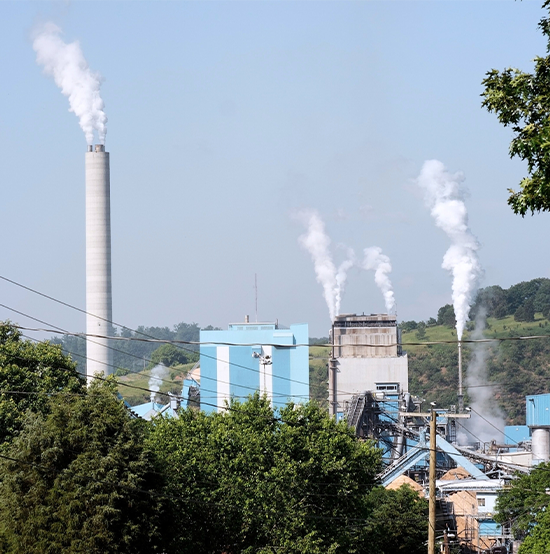
Crude Tall Oil (CTO) is a renewable, bio-based feedstock generated as a by-product of the Kraft pulping process. Through downstream refining and fractionation, CTO can be separated into valuable products such as Tall Oil Fatty Acids (TOFA), Tall Oil Rosin (TOR) and Distilled Tall Oil (DTO), which are used in lubricants, adhesives, coatings, specialty chemicals and renewable fuels.
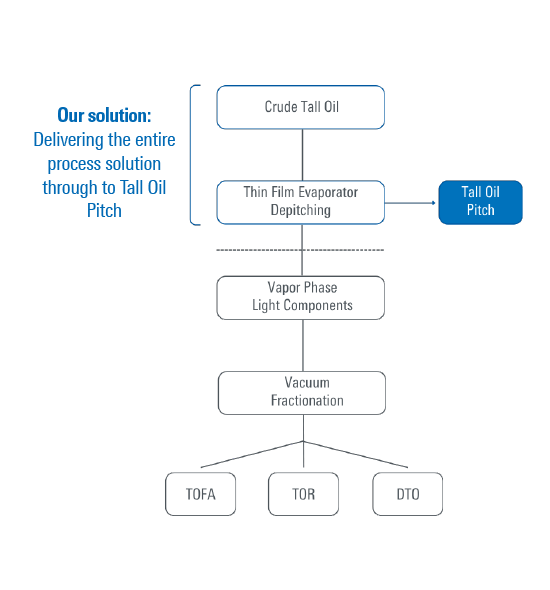
Prior efficient fractionation can take place, the high boiling pitch fraction must be removed. Thin film distillation (wiped film distillation) has become an established industrial solution for this critical depitching step.
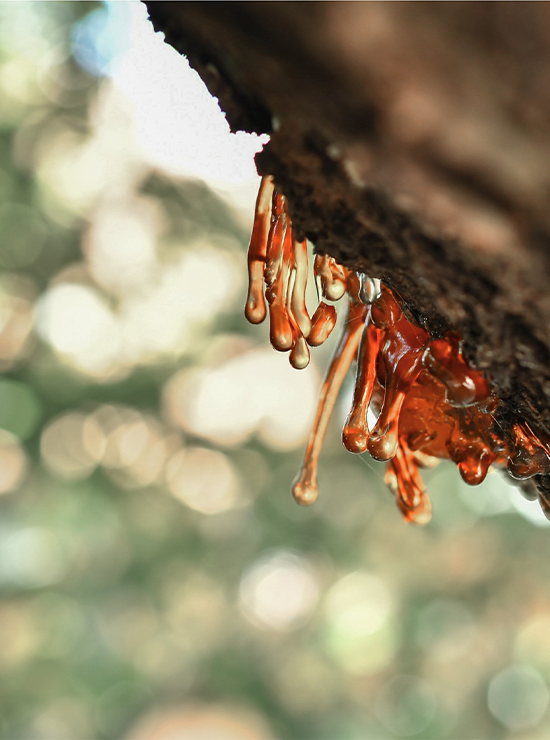
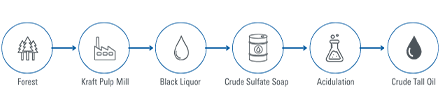
From Forest to Crude Tall Oil
Tall oil originates from the Kraft pulping process, the dominant technology for the production of chemical pulp from softwood species. During pulping, naturally occurring extractives such as fatty acids and rosin acids react with the alkaline pulping liquor and form sodium soaps. These soaps accumulate in the black liquor and can be recovered as
crude sulfate soap. The recovered crude sulfate soap is subsequently acidulated with sulfuric acid, converting the sodium salts into free organic acids and producing
Crude Tall Oil (CTO).

Crude Tall Oil is not a single compound but a complex mixture of several valuable component groups. The exact composition depends on wood species, pulping conditions and mill operation.
Typical CTO fraction:
Crude Tall Oil Composition (typical)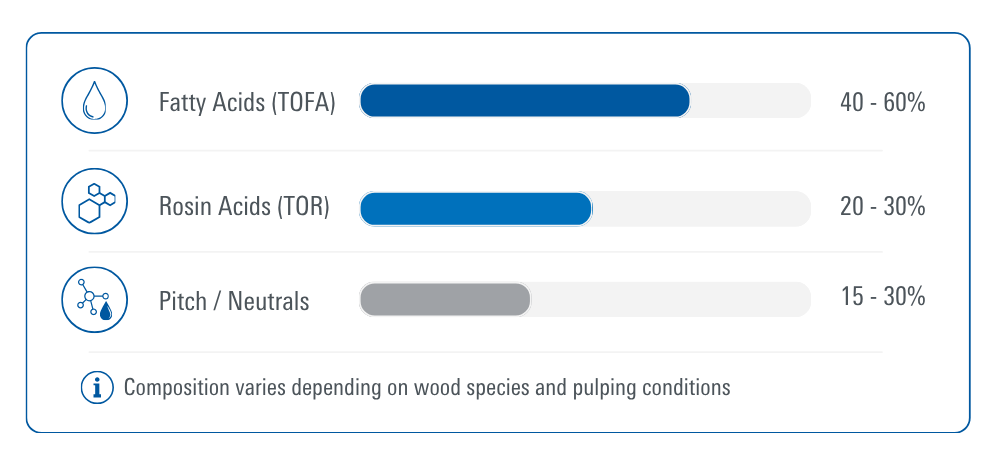
Calues shown represent indicative ranges reported in the literature and may vary depending on wood species, pulping process and operating conditions.
Tall Oil Pitch (TOP) represents the highest-boiling fraction, modern CTO refining schemes typically include a dedicated depitching step
before further vacuum fractionation and production of commercial tall oil products.
If pitch is not removed before fractionation, deposits can form in downstream distillation equipment,
potentially reducing operational reliability and product quality.
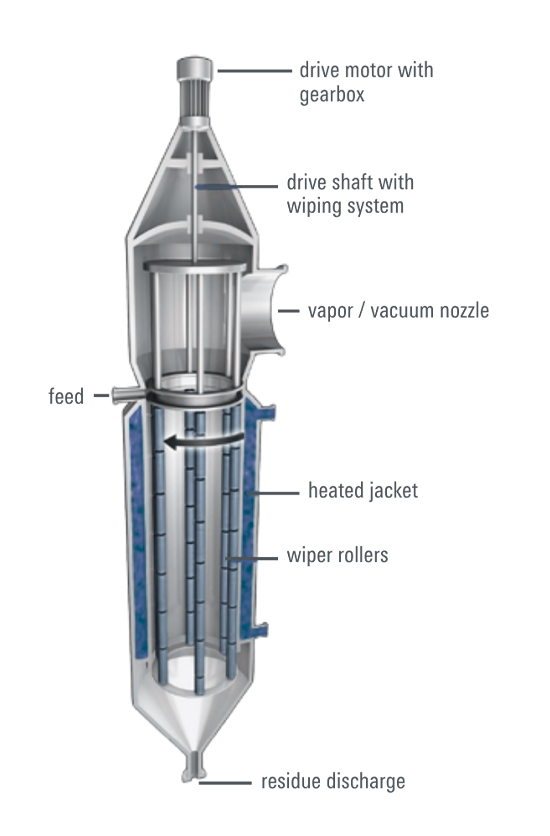
Thin film evaporators (wiped film evaporators) consist of a cylindrical heating jacket and an inner rotating wiper system, distributing the product on the inner evaporator plate as a
thin and turbulent film. The turbulence in the thin film increases the heat and mass transfer to achieve a high evaporation rate at short residence times. The vapours are either condensed on an external condenser or further separated in a ractional column.
Thin film evaporation (wiped film evaporation) allow reliable processing of heat-sensitive, fouling and viscous tall oil streams, even at high throughput rates.
The depitching step in tall oil processing is a complex thermal separation operation. Equipment must reliably handle:
Special Metallurgy
Due to its high corrosion resistance, AISI 904L (EN 1.4539) is widely used for product-wetted components in tall oil processing applications. Manufacturing large-scale equipment from this highly alloyed material requires advanced fabrication capabilities and stringent quality control procedures. Our expertise enables the cost-effective production of large thin film evaporators (wiped film evaporators) and pressure vessels in EN 1.4539, combining process reliability with long service life.
Following depitching, CTO is further processed through vacuum fractionation into several valuable product streams.
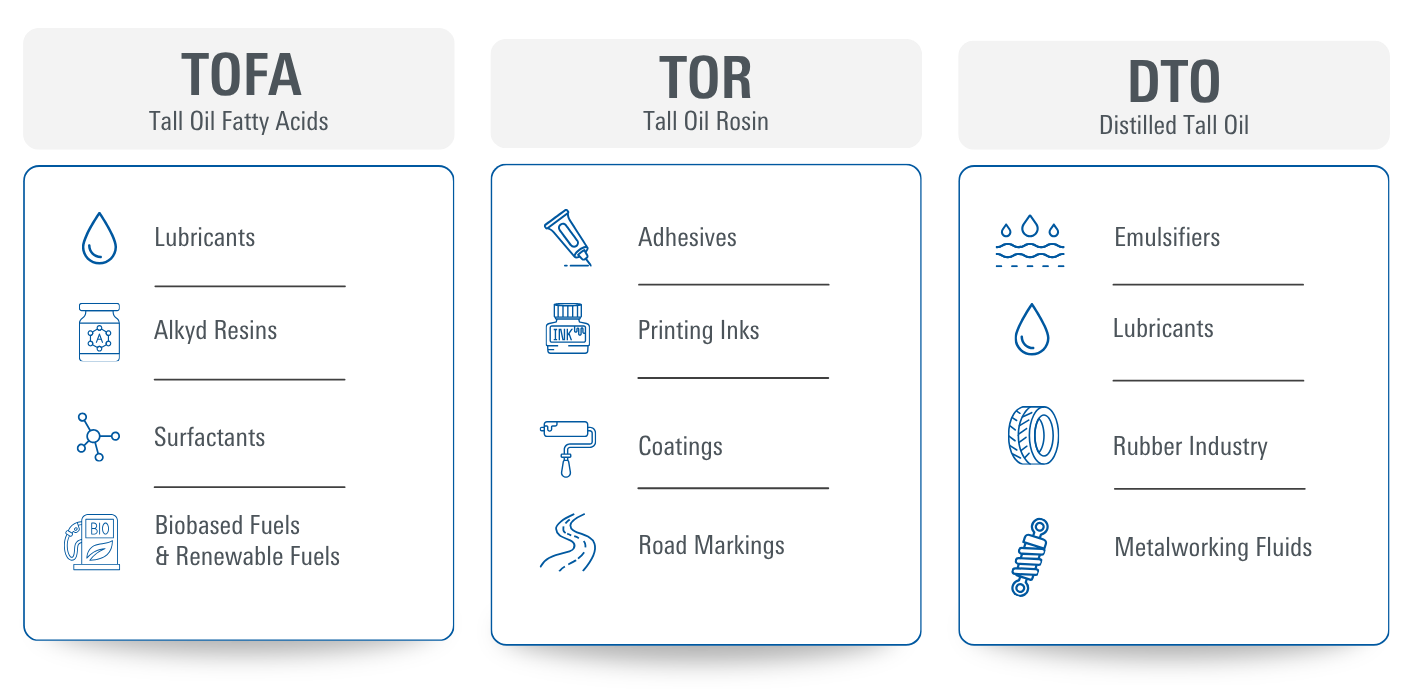
Crude tall oil (CTO) is increasingly valued as a renewable feedstock for bio-based products and renewable fuel applications.
As a by-product of the Kraft pulping process, it offers a favorable sustainability profile and does not require dedicated agricultural land.
Growing demand and limited availability make efficient utilization of CTO increasingly important.
Regardless of the final product slate, the removal of tall oil pitch remains a critical processing step.
Efficient depitching is required to enable reliable downstream fractionation and recovery of valuable CTO-derived products.
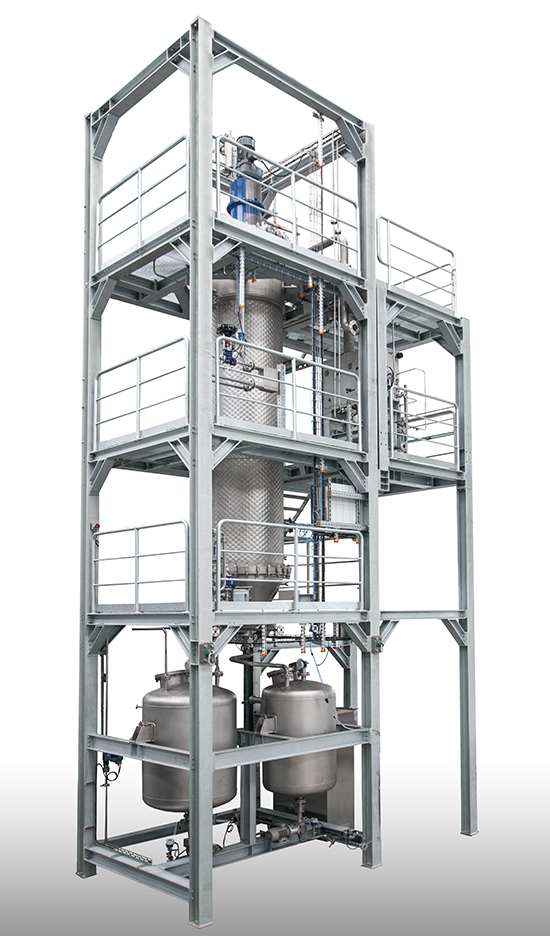
Traditionally, Tall Oil Pitch has been regarded as the heavy residue produced during CTO fractionation. However, increasing attention is being paid to the valuable components still present within this stream.
Tall Oil Pitch contains an unsaponifiable neutral fraction including phytosterols and other neutral compounds. Several patented industrial processes explicitly describe the recovery of sterol-rich fractions from Tall Oil Pitch.
For example, EP2252675 states:
"The invention especially relates to the separation of the sterol neutral substances by means of high vacuum distillation/evaporation."
Similarly, WO2022117922 describes:
"The separation of the sterol neutral substances from tall oil pitch (TOP) by means of distillation or evaporation."
These developments demonstrate that Tall Oil Pitch may represent not only a residue stream, but also a potential source of future value creation. While the focus of this case study is CTO depitching rather than sterol recovery, the presence of valuable compounds in Tall Oil Pitch further highlights the importance of efficient pitch handling and separation.