MOSH & MOAH - Case Study

In the early 1990s, the public laboratory of Zurich, Switzerland, detected contaminated bakery ware and candies, containing up to 0.1 % mineral oil (1000 ppm). The food products absorbed paraffin oil present on the production surfaces and the processing knives. In addition it was detected that the packing material of products like rice and milk powder emitted mineral oil as well; I.e. the fibers of the jute bags and the printing on the cardboards (Grob 2023).
By 2014 Barp et al conducted a study about the accumulation of mineral oil saturated hydrocarbons (MOSH) in the human body. Samples of the human tissue and mother milk contained between 50 and 200 ppm hydrocarbons (0.005 to 0.02 %) (Barp 2014).
‘Food watch’, ‘Stiftung Warentest’ and ‘Oeko test’ analyzed hundreds of products. By 2019 ‘Food watch’ identified 16 baby milk powders with a concentration of 2-3 ppm MOAH (Sumner 2023). By 2020 the EU limited the concentration of mineral oil aromatic hydrocarbons (MOAH) in infant food and recently for all food categories. The maximum allowable MOAH concentration in edible oils is 2 ppm (Vanheusden, 2023).
VTA and UIC have already designed, built, and supplied severalplants for the removal of MOSH and MOAH from vegetable oils. In addition, we have many times demonstrated on our pilot plant that our short-path distillation technology can achieve residual MOAH concentrations of 10 ppm, 5 ppm, and even less than 2 ppm. Based on our experience, the average MOAH contamination levels in for example palm oil, olive lampante oil and olive pomace oil are as follows: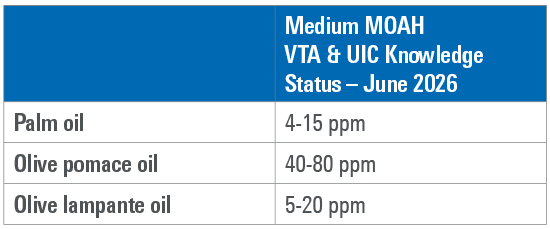
The terms MOSH and MOAH stand for a wide range of molecules, from 10 until 50 hydrocarbons (C10-C50). The smaller molecules usually evaporate in the oil refining and deodorization process. Anyway, it seems that MOSH components are less harmful for the human health compared to MOAH. The longer chain, 3 to 7 ring MOAH molecules, are considered to be carcinogenic and mutagenic (Tietz 2023). The reduction of those MOAH components represents a major technical challenge.
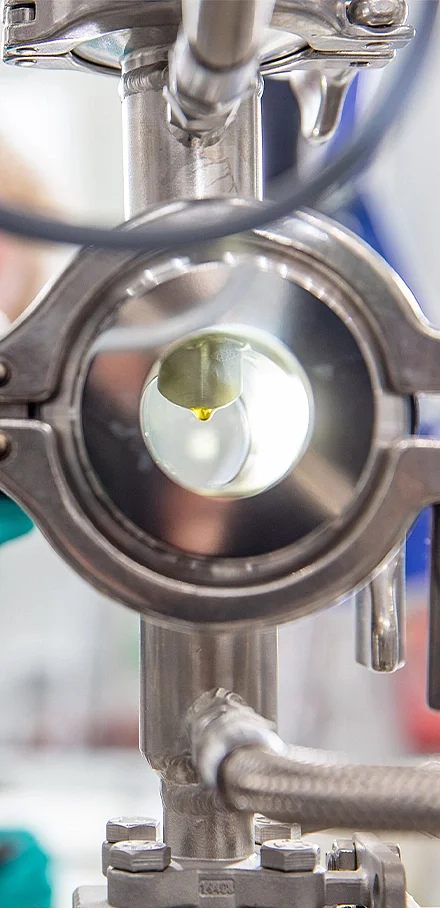
Short path distillation (SPD) is a thermal separation process for the removal of pollutants and the concentration of thermal sensitive substances. One of the applications is the distillation of edible oils, including the following possible processes.
Distillation of edible oils:
The SPD process has already been used to remove FFA and pesticides from palm and fish oil before the discussion on MOSH and MOAH removal got more and more relevant. The processes for the removal of pesticides and MOSH/MOAH are based on the same fundamentals. Short path distillation is a continuous vacuum distillation process. A wiper in the middle of the cylindrical evaporator distributes the oil to a thin film on the heated evaporator wall. Lighter boiling components (like MOSH/MOAH or pesticides) have the chance to evaporate out of this highly turbulent thin film.
The distillation temperature and pressure are set depending on the type of the processed oil. The evaporation rate is typically in the range of a few percent. The distillate fraction is containing the discussed contaminants, whereas the concentrate fraction represents the purified product. The short chained hydrocarbons have a boiling point range which allows an efficient separation with correspondingly high yield. The long chain hydrocarbons are in a similar vapor pressure range as many other valuable components of the oil, therefore their separation is much more challenging.
By 2020 Nutriswiss reported about the process of MOSH & MOAH reduction with a SPD, manufactured by VTA (Nutriswiss, 2020). The distillation plant was delivered as a turn-key skid mounted package unit including apparatuses, piping, valves, steel structure and control system. The delivery of the plants in pre-assembled modules allowed a fast and efficient installation and start-up procedure.
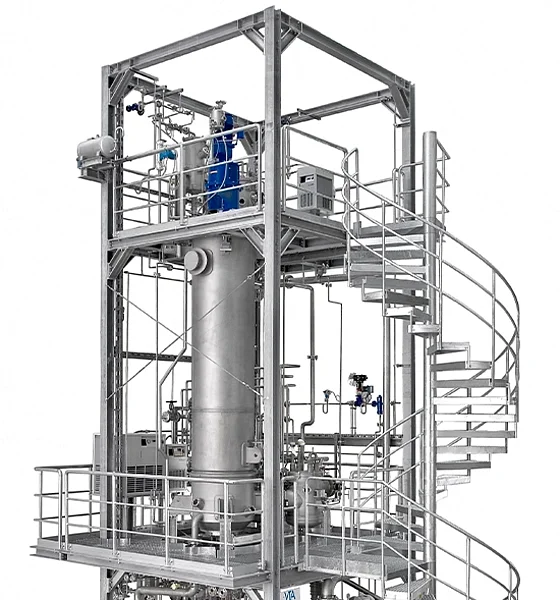
Nutriswiss uses plant and animal raw materials to manufacture a wide range of oils with specific properties for the food industries, the retail trade as well as pharmaceutical and cosmetics companies. The Swiss-based edible oil specialist has moved to expand its refining operations with new industrial scale short path distillation equipment. The process is optimized to reduce free fatty acids, plasticizers, pesticides, mineral oil residues (MOSH/MOAH) and mono- and diglycerides from a wide variety of crude edible oils.
www.nutriswiss.ch

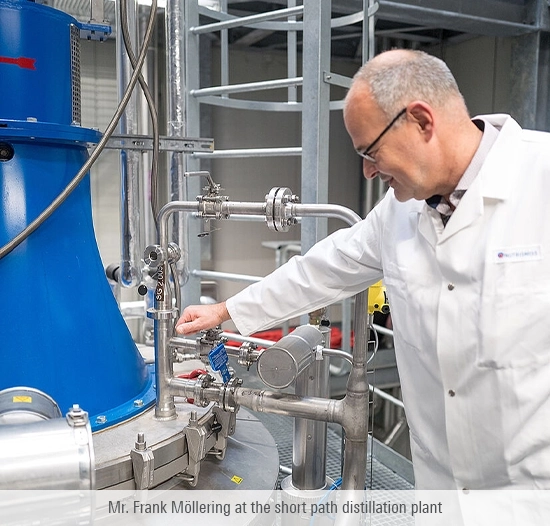
“The process for the removal of mineral oils was developed with a VTA glass evaporator. In addition we are cooperating with the farmers and producers to source edible oils with a low contamination level as starting point for the distillation. The purity of the distilled oil is very high. The oil refining is offered as a tolling service and the type of product changes several times per week. An efficient cleaning procedure was established to switch i.e. between marine and plant oils within a short time. As the regulations are becoming stricter, the demand for this service is increasing significantly.”